


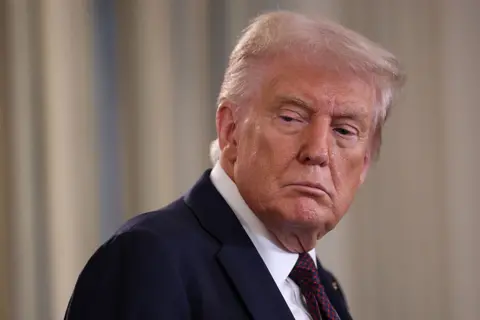
Our nation's highest court starts its current docket on Monday containing a schedule currently loaded with potentially major disputes that could establish the limits of executive presidential authority – plus the chance of additional cases to come.
During the past several months since the President was reelected to the Oval Office, he has pushed the limits of presidential authority, independently implementing new policies, slashing federal budgets and personnel, and trying to place once independent agencies closer subject to his oversight.
Judicial Conflicts Over National Guard Use
An ongoing brewing court fight arises from the president's attempts to take control of local military forces and dispatch them in cities where he claims there is social turmoil and widespread lawlessness – over the objection of municipal leaders.
In Oregon, a judicial officer has handed down rulings blocking Trump's deployment of troops to the city. An appellate court is set to examine the decision in the near future.
"Ours is a nation of judicial rules, rather than army control," Judge the presiding judge, that the administration selected to the court in his initial presidency, stated in her Saturday statement.
"Government lawyers have offered a range of arguments that, should they prevail, endanger weakening the line between non-military and armed forces national control – undermining this country."
Shadow Docket May Decide Defense Control
After the appellate court has its say, the High Court might intervene via its so-called "shadow docket", delivering a ruling that may limit the President's power to use the armed forces on American territory – conversely grant him a broad authority, at least temporarily.
Such processes have turned into a more routine occurrence lately, as a greater number of the judicial panel, in response to urgent requests from the Trump administration, has largely permitted the administration's policies to continue while court cases play out.
"A tug of war between the High Court and the trial courts is set to be a major influence in the coming term," a legal scholar, a instructor at the Chicago law school, stated at a conference in recent weeks.
Concerns Over Emergency Review
Judicial dependence on the shadow docket has been criticised by progressive legal scholars and officials as an inappropriate exercise of the legal oversight. Its decisions have usually been short, offering limited explanations and leaving district court officials with minimal guidance.
"The entire public must be worried by the High Court's increasing reliance on its shadow docket to decide disputed and notable disputes without any form of transparency – no comprehensive analysis, oral arguments, or reasoning," Legislator the lawmaker of his constituency commented previously.
"That additionally pushes the judiciary's discussions and judgments out of view civil examination and shields it from accountability."
Comprehensive Proceedings Ahead
In the coming months, though, the judiciary is preparing to tackle issues of presidential power – as well as further high-profile controversies – head on, holding oral arguments and providing comprehensive judgments on their basis.
"The court is will not be able to one-page orders that omit the justification," said Maya Sen, a scholar at the Harvard University who focuses on the judiciary and US politics. "Should they're planning to grant more power to the executive its will need to explain the reason."
Key Cases within the Agenda
Judicial body is presently set to consider the question of national statutes that bar the head of state from removing personnel of agencies designed by Congress to be self-governing from White House oversight undermine presidential power.
Judicial panel will further hear arguments in an fast-tracked process of Trump's effort to dismiss an economic official from her role as a official on the key monetary authority – a case that may substantially increase the administration's control over US financial matters.
The nation's – plus international economic system – is also a key focus as court members will have a chance to rule on whether many of the President's solely introduced duties on overseas products have adequate statutory basis or must be voided.
Court members could also examine the administration's efforts to independently cut government expenditure and terminate subordinate federal workers, in addition to his aggressive migration and deportation policies.
Even though the judiciary has so far not consented to consider the President's effort to abolish natural-born status for those born on {US soil|American territory|domestic grounds

